


Beyond Rankings: My Keyword Strategy for the AI Search Era
- Guanying Wang
- Apr 11
- 6 min read


SEO · SEM · AEO · GEO · April 2026 · ~6 min read
Why Search Is the Center of My Campaign
When I started building my final project marketing campaign, I kept asking myself: how do people actually find a brand they've never heard of before? The answer is almost always search. Whether someone types a question into Google or asks ChatGPT for a recommendation, search is usually the first step in the discovery process.
That's why keyword strategy isn't just an SEO task — it's a core part of my whole marketing plan. The keywords I choose shape my website content, my social media posts, and even my product descriptions. They help me answer one important question: what words does my audience use when they're looking for what I offer?
To figure that out, I used AnswerThePublic to discover the real questions people ask around my topic, and Google Keyword Planner to check search volume and competition. These tools helped me go from guessing to actually knowing what my audience wants.
For my final project, I chose Airbnb as my brand — and search sits at the very center of how Airbnb wins customers. Travelers don't stumble upon Airbnb by accident. They search "unique stays in Kyoto" or "pet-friendly cabin near Lake Tahoe" — and Airbnb needs to show up at every single one of those moments.
Organic Search (SEO): Building Long-Term Visibility

SEO is where I'm putting most of my energy because it builds value over time. The idea is simple: create content that matches what my audience is searching for, so my pages show up when they need them most.
I'm using a content cluster model — one main "pillar page" covering my core topic, supported by smaller blog posts going deep on specific questions. This structure builds what SEO experts call "topical authority," which helps Google understand that my site is a reliable source. As EWR Digital's 2026 SEO guide notes, building keyword clusters rather than targeting one keyword per page "boosts both rankings and topical authority significantly."
Here's how I'm mapping keywords to funnel stages:
Awareness stage — Informational keywords like "What is X" or "How does X work." These build trust at the top of the funnel.
Consideration stage — Comparison keywords like "X vs Y" or "Best X for beginners." These help people evaluate their options.
Decision stage — Commercial keywords like "Buy X" or "X price." These are high intent and closest to a purchase.
What makes Airbnb's SEO interesting is that there are actually two layers of search happening at once. The first is Google — where travelers are still in research mode, comparing Airbnb against hotels or other platforms. The second is Airbnb's own internal search algorithm, which ranks listings based on factors like response rate, pricing competitiveness, and review quality. A keyword strategy for Airbnb has to work on both levels: winning the Google result that brings someone to the platform, and then winning the Airbnb search result that gets them to book a specific listing.
On the technical side, every page needs a clear title tag, meta description, and Schema.org structured data markup so search engines and AI tools can understand what my content is about. I use Google's Rich Results Test to make sure everything is set up correctly.
Key insight: EWR Digital puts it well — "keyword research today is about understanding user intent, not just chasing volume." This is exactly why I map keywords to funnel stages instead of just picking the words with the highest search numbers.
Paid Search (SEM): Getting Results Faster
While SEO takes time, paid search through Google Ads gets my campaign in front of the right people right away. I plan to use SEM mainly during the launch phase and for high-intent keywords that are too competitive to rank for organically.
Here's my SEM plan:
Brand protection — Bid on my own brand name so competitors don't steal my traffic. This runs all the time.
Intent-based targeting — Write different ad copy for awareness vs. decision-stage keywords, so the message matches where people are in their journey.
Remarketing — Show ads again to people who visited my site but didn't convert. This is more cost-effective than targeting cold audiences.
Competitor keywords — Appear when people search for similar brands, if the budget allows.
One underrated benefit of running paid search: the Search Terms Report in Google Ads shows the exact words real people typed before clicking my ad. That's live audience data I can feed directly back into my SEO content strategy. SEM and SEO are much more powerful
when they work together.

AEO & GEO: The New Frontier I Can't Ignore
This is the part that feels most exciting — and most urgent. Search behavior is shifting fast. More and more people skip the list of blue links and go straight to AI tools like ChatGPT, Perplexity, or Google's AI Overviews when they want a quick answer.
According to Jasper's GEO vs. AEO research, AI referral traffic to top websites grew 357% year-over-year between 2024 and 2025. But there's a catch: AI Overviews also caused a 34.5% drop in click-through rates for top-ranking pages. More exposure, fewer clicks — that's the new tension every marketer has to deal with.
Why this matters: Writer's triple-optimization guide cites Gartner's forecast that "by 2026, traditional search engine volume will drop 25%." The goal has shifted: it's no longer just about ranking — it's about getting cited by AI as a trusted source.
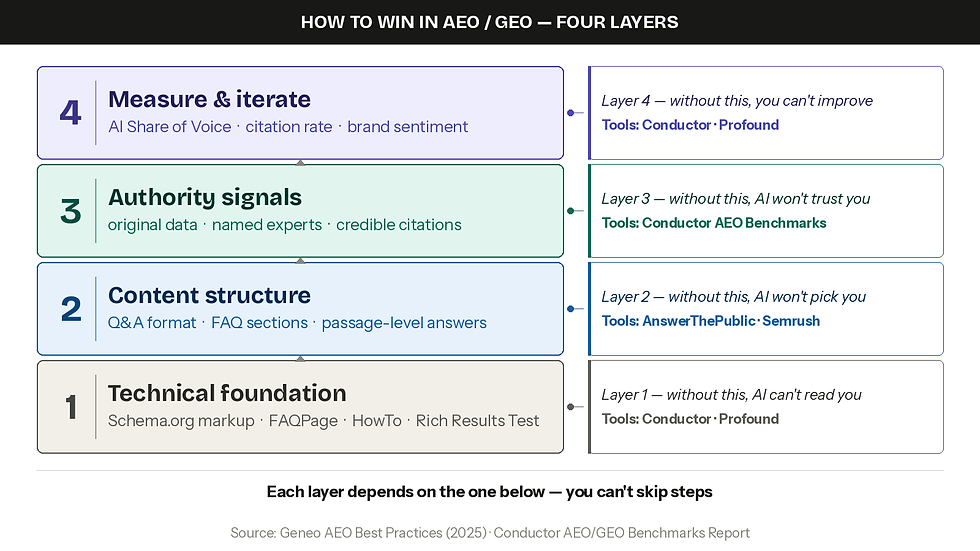
So how do I actually compete in AEO and GEO? After going through several industry reports, here's my four-part plan:
1. Write in Q&A format. AI engines love content that directly answers a specific question. According to GRM Digital's SEO 2.0 guide, "AEO is all about understanding the intent behind user queries and structuring your content to meet those needs." In practice, this means adding FAQ sections to all my major pages.
2. Use structured data markup. Adding FAQPage and HowTo schemas makes it much easier for AI tools to extract and cite my content. The Amsive AEO strategy guide explains that schema markup is one of the clearest signals you can send to both traditional and AI search systems.
3. Build credibility with data and named experts. Conductor's AEO/GEO Benchmarks Report — based on analysis of over 100 million AI citations — found that content with original statistics and expert attribution gets cited far more often. So I'll include real data, proper author bios, and links to credible sources.
4. Optimize at the passage level, not just the page level. As BOL Agency's B2B SEO guide explains, "AI systems dynamically retrieve relevant content passages at query time." This means a single well-written paragraph can get picked up and cited. Every section needs to stand on its own.
What success looks like: Instead of just tracking keyword rankings, I'll also track AI Share of Voice (how often my brand appears in AI answers) and citation rates — metrics recommended by Geneo's AEO Best Practices guide. I'll use Conductor and Profound to monitor AI visibility.
How It All Fits Together Across Channels
The keyword strategy doesn't live in just one place. Here's how I'm applying it across different marketing channels:
Website / Blog — Long-tail questions + brand terms → goal: SEO rankings + AI citations
Social Media — Topic hashtags + trend-based phrases → goal: awareness + backlink building
Google Ads — High-intent commercial keywords → goal: fast conversions + audience data
AI platforms (ChatGPT, Perplexity) — Conversational, question-style phrases → goal: brand citations + trust signals
The big takeaway is that SEO, SEM, and AEO/GEO are not three separate strategies — they're one strategy running across three channels. As MD Marketing Digital puts it, "SEO, GEO, and AEO are stages of the same journey. Brands that understand this will connect better with their audience, no matter the channel."
And the conversion data supports investing in all three. According to CMSWire's search playbook analysis, citing Semrush research, visitors who come from AI platforms convert 4.4 times better than visitors from regular organic search. So even if AI sends fewer clicks, those clicks are worth a lot more.
Airbnb Thinking
For Airbnb specifically, I think the biggest opportunity right now is in AEO/GEO. When someone asks ChatGPT "is Airbnb worth it for a family trip to Japan?" — Airbnb should be the brand that gets cited as the authoritative answer. Airbnb already has the data, the reviews, and the real traveler stories. The gap is in making that content structured and extractable so AI engines can actually use it. That's a gap any host, marketer, or brand manager can start closing today.
My Final Takeaway
The goal used to be: rank #1 on Google.
The goal now is: be the answer — wherever people are asking.
Whether that's a search results page, a paid ad, or a ChatGPT response, my keyword strategy is built to show up in all three places. That's what integrated search marketing looks like in 2026.
Sources: Jasper · Writer · Conductor / ALM Corp · CMSWire · Amsive · GRM Digital · BOL Agency · Geneo · EWR Digital · MD Marketing Digital


Comments